Search This Blog

Friday, 28 March 2014

March month of madness!

Vicky Adin at Takapuna Library, Monday 24th March 2014

Well, we're almost at the end of March and there's only one writer event left on our public speaking calendar up in Helensville on Wed 9th April. (At the library, 10.30 - 11.30am.)

It has been a very interesting exercise. We've had a variety of turnouts to our events and trialled a range of locations and time slots for  reaching our audience - but the great thing is that however many attendees we've had, their response has always been positive, supportive, and interested, and we have made many useful new connections and allies.

Some of the pillars of the literary community are taking us more seriously now! We're here, we're growing, and we're doing good work.

Of course there is always more to be done to fly the flag of local publishing, and we'll be getting right on to that in time, but I'm sure others in the Mairangi Group will share my quiet feeling of relief that March is over, and now we can get back to writing.

I can't wait to get back to my story and see what happens next!

Bev Robitai


Thursday, 20 March 2014

March - Writers' Month

There are still a couple of public events for March when Mairangi Writers are flying the flag for local publishing. Friday 21st at Orewa Library, 10.30am, and the main event at Takapuna Library on Monday 24th March from 6pm. Bring all your questions about writing and publishing and we'll have answers for you!

Gabrielle Rothwell remembers Les Andrews


Inevitably with the passing of someone who has been a part of one’s life for over fifty years childhood memories are resurrected which for me incur a sense of longing for those days of long ago.
 
On Tuesday 11 March I attended the funeral at St Andrew’s First Presbyterian Church in Symonds St of a very old friend. His name was Les Andrews QSM and he was aged 96. Who was Les Andrews, you might ask? Well, if you were living in Auckland during the 60’s through to the 90’s you couldn’t help but recognise the name. Les was one of New Zealand’s oldest entertainers - an entertainer extraordinaire – the actor and singer from Timaru to the Palladium, a man of incredible talent. During his long life he did it all - firstly with the famous Kiwi Concert Party during the war, then afterwards graduating from the Royal College of Music in London.  As a principal soloist he performed all around Britain as well as broadcasting with the BBC, a quizmaster and interviewer, comedian, pioneer of the early days in television (in both Britain and New Zealand), entrepreneur, and tireless worker for charity. He was an extremely gifted man and over his long and varied life (over sixty years as a performer) gave pleasure to millions.

 He battled long and hard to save Auckland’s beautiful old Customhouse which earned him the Queens Service Medal and who could forget Les singing “Click Goes The Toll Gate, click, click, click…” when the Auckland Harbour Bridge was opened – a record which would go on to sell thousands of copies.

 When I was thirteen I moved to Glendowie with my family and one morning while waiting for the bus to take me to my new school in the city I met Jenny Andrews who was going to the same school. We immediately hit it off and later I met her talented musical family – her mother Marie Campbell, contralto and music teacher, her two brothers, David and Robert who played the flute and the clarinet, and Jenny herself, a gifted soprano.

 There followed many years of fun and laughter throughout our teenage years – so many memories - going backstage to watch Les performing, the TV studios in Shortland Street when, in the sixth form, we tried out for one of Les’s quiz shows (it never got to first base!), Jenny and I singing songs from The Sound of Music and My Fair Lady to Les’s praise, Christmas holidays in Gisborne where I would meet many performing artistes, Les giving me away when I got married, and later after Jenny’s mother died and he married Sonia King attending their many variety concerts in Auckland’s Town Hall and Aotea Centre. Les and Sonia brought the house down with The White Cliffs of Dover at one of my book launches. One final memory of Les and Sonia at my house-warming in Takapuna and the two of them sliding out the door at midnight on a sea of wine! How they made it home in one piece is one of life’s great mysteries.

 As Jenny said in her eulogy: “Well Dad, this is your final show. The venue is sorted, the tickets sold, the programmes printed, the seats are full.” And what a show it was - a great and talented cast of many from all walks of life, tributes pouring in for a remarkable man who had led a rich and rewarding life. And the music, a beautiful and fitting reminder of a man who had an ability to enchant with his singing.

It was a send-off to remember.  


RIP Les.     

Gabrielle Rothwell


Thursday, 13 March 2014

Bev Robitai on focusing your aim as a writer.


If you’re looking for competent, sensible, successful writers to follow for inspiration and advice, you could take a look at Joanna Penn. One of her latest blog posts has advice that is worth revisiting several times in your career as your aspirations and skills change. Here’s the link http://www.thecreativepenn.com/2014/03/01/definition-of-success/

Her basic premise is that you need to decide what you want to achieve with your writing. Fame? Fortune? Literary prizes? Or simply the satisfaction of holding a book in your hand (in print or on an ereader.) It shouldn’t change HOW you produce the work – you’ll always want to make it the best it can be and produce it to the highest standards, but it may help you decide how much work you’re prepared to do to promote it.

If you want to get your book on shop shelves, are you willing to spend time trying to find bookstores to stock it? If your definition of success is to be in a major book chain it will take considerable effort and resources. Even getting into indie bookstores is an uphill battle at times. If that’s not for you, you might prefer promoting your ebook online. Can you face contacting reviewers, listing it on Goodreads, doing promotions and giveaways? It takes a fair bit of time and effort to achieve that miraculous overnight rocket to stardom! If you seek literary prizes, will you hunt out competitions and pay the entry fees?

I like Joanne’s last points – you can seek to make a liveable income from your writing, and you can aim to leave a body of work that you’re proud of. The two are not mutually exclusive but you’ll need to have a clear idea of what’s important to you to achieve success in either.


Happy writing!


Bev Robitai

Thursday, 6 March 2014

Mary Elsmore-Neilson on a Poetry Workshop


At the January Waiheke Poetry Workshop, amidst native bush, gentle rays of sun plus a thunderstorm, (I thought we, our island might float, be blown away) flustered bulky woodpigeons flapping about and bossy, warbling tuis, our creative juices were stoked then flowed. Each morning, us four participants, had to select a verb and a noun from the Mind Gym cup of words and write furiously for five minutes to warm-up.


We stretched our writing muscles just as we would stretch before exercise. Over the week we explored five of the, at least, 21 senses: visual, gustatory, tactile, auditory and olfactory to create sense-mixing imagery.

 We discovered the power of what is not there, ie: how metaphors 'speak' to the reader of a mood, allowing the words to direct the reader's understanding of the words as with Kate Farrell's, (American, b.1946)


                    'The Double Bubble of Infinity'

                    The night before the day of our wedding

                    I dreamed that the universe had a party,

                    All the stars were invited,

                    Beneath sparkling chandeliers, the planets

                    rejoiced:


                    In all its beautiful candle-lit galaxies,

                    Crowded with glass-clinking revellers,

                    The Cosmos was Laughing with

                    Lasting Love and Light.

 
We saw that Capital letters can add extra meaning, learnt not to use BOMB words which tend to do that to a piece if not appropriate, how motion and active vision can encapsulate the energy/movement of an extraordinary moment whereas words like snow promote a stillness, a freezing static; plus the importance of a good ending, as in Ted Hughes, 'Roe-Deer' (possibly written in the 1960s.)

 I liked Seamus Heaney's comment from 'HOMAGE TO ROBERT FROST,
Frost believed...that individual venture and vision arose as a creative defense against emptiness...'

 Some remarkable poetry was produced as we worked together to deadlines, each of us having a very different style. On the last day we performed to invited guests, along with the other Print and Sculpture Workshop participants. A nice conclusion to our workshop week.


This past Tuesday I was invited to read as part of six writers, which included the inspirational Jacqueline Fahey, at Takapuna Library. It was a part of Anita Arlove's award-winning 'Spit It Out' which premiered in the 2013 Fringe Festival. I chose my 'Soliloquy,' written for a 2012 NZSA monthly competition, which tends to make people laugh with its purplish and lively language and my new 'Master Chef' written during the above workshop. As a Grand Wrapper, A Baby Boomer, I performed this ironic poem about love, as a rapper; a Performance Poet, which was marvelous fun. 

 There will be two more Spit It Out events, all well worth attending. Go to www.spit.it.out for more details.

The poetry workshop, an annual event, was excellent. It was great to just 'hang' around with words and play. I do recommend the event and now there is a possibility that our poems will be published by the Waiheke News.


Kia pai to ra. Enjoy your day.

Mary Elsmore-Neilson 


Friday, 28 February 2014

WOMEN WRITERS: UNDER-SERVED AND UNDER-VALUED.


Erin McKechnie writes...
With apologies to the male writers I know struggling to be recognised, I have précised an interesting article by Alison Flood published in The Guardian Weekly on 7th February. It would be nice to think it would challenge some of the publishers and book sellers in New Zealand, but I have little confidence they would even read it.

Figures last year from Vida, the American organisation for women in the literary arts, show the huge imbalance in how male and female writers, and reviewers, are treated. At the New York Review of Books, for example, 16% of the reviewers were women, with 22% of the books reviewed written by women.  A similar investigation in the Guardian revealed that the situation in the UK is no better.  In March 2013, 8.7% of books reviewed in the London Review of Books were by women, rising to 26.1% in the New Statesman, and 34.1% in the Guardian.

Daniel Pritchard, editor of the journal Critical Flame, has announced a year dedicated to women writers and writers of colour, citing the Vida figures as part of the reason for his decision and saying, “nothing will change if people do not act morally within their spheres of control”.

“Women writers and writers of colour are under-served and under-valued by the contemporary literary community,” he writes. “Silence on this literary disparity has not been the problem over the past few years. Inertia has.”

Author Joanna Walsh determined to do her bit to redress the imbalance and started the ‘#readwomen2014’ project. It started with a few Christmas cards which dubbed 2014 ‘the year of reading only women’, listing the names of 250 women writers and encouraging recipients to actively choose to read books from those authors. She was inundated with requests for more cards and suggestions for other women authors to include.

Not only did the women respond positively; many men apart from Pritchard have made reading resolutions of their own. Authors and readers such as Matthew Jakubowski, Lilit Marcus and Jonathan Gibbs have all undertaken to read only women writers. Jakubowski, an American author and literary critic has resolved to read – and hence review – only books by women in 2014. In his words – “if we don’t decide to do the work it takes to find valuable, important books by women and under-represented authors, we will continue to miss them and the loss will be ours.”

He believes news outlets still favour men over women when it comes to book coverage and that publishers are more likely to spend large sums on male writers. “The result of this investment by publishers is that readers and literary critics are guided towards books by men.”

Gibbs, an author and journalist for the Independent undertook his women-only reading stint after “reading Ben Lerner’s Leaving the Atocha Station and basically getting peed off with that self-reflexive, ‘I know I’m a shit and that makes me great’ male narrator type story.” Essentially, he recognised he was reading through the filter of male consciousness and further, that the book industry and media largely colluded in, or constructed the idea that male writers are best. Gibbs assumes this is largely cultural and comes down to the de Beauvoir quote about man being defined as a human being and a woman as female, ie ‘Look, that’s the great literature, see how it writes about the human condition!’  when in fact it’s only writing about the male condition.

Of the publishers who have pulled out of New Zealand in the last decade, how many were headed by men, do you think?

Erin McKechnie
Saturday, 15 February 2014

Jenny Harrison - proud of NZ indie publishers


The future is bleak. New Zealand books written by New Zealanders about their land and its people may soon be a thing of the past. Because of the changing nature of world economics, many of the big publishing houses have deserted us. Over the recent past we have lost Penguin, Hachette, HarperCollins and a bunch of others, leaving hundreds of bright, creative and accomplished writers with no opportunity for ‘big-time’ publication and having, in the final score, to fend for themselves.

There are budding Eleanor Cattons, Janet Frames and Lloyd Joneses among us but, given the problems we now face, they may never see the light of day.

But wait, as the advert says, there is more! And that ‘more’ is the proliferation of self-publishing or, as we prefer to call it, ‘indie’ publishing.

To say that we Kiwi writers have taken to self-publishing like the proverbial ducks to water is an under-statement. In spite of indie publishing being challenging and scary, New Zealand writers are finding their feet in this demanding new arena and are set to reach new heights.

There are downsides to indie publishing, one being the inability of media book reviewers to see beyond their noses and give us the opportunity to prove ourselves. Another challenge is that the big book sellers are reluctant to stock our books, largely due to bookkeeping problems. Small independent book sellers are far more accommodating – if you want a good book then go there first! The other is that libraries, our mainstay, have shrinking budgets. They tend to buy a limited number of books and then shuffle them around to their branches. In my humble opinion, it would probably be cheaper to buy more books than spend the money on petrol ferrying them to and fro. However....

Another downside is the technology, a fearsome ogre to anyone who isn’t on first name terms with their computer.

On the upside you have cart blanche to make as big a mess as you like of chaotic editing, a book cover designed by your wife and loads of grammar- and spelling mistakes. Just kidding! Those are elements that define a self-published book and you, being smart, modern and savvy, are not going to make those errors. You are going to get a professional editor and a book cover that looks as if it was designed by Gucci.

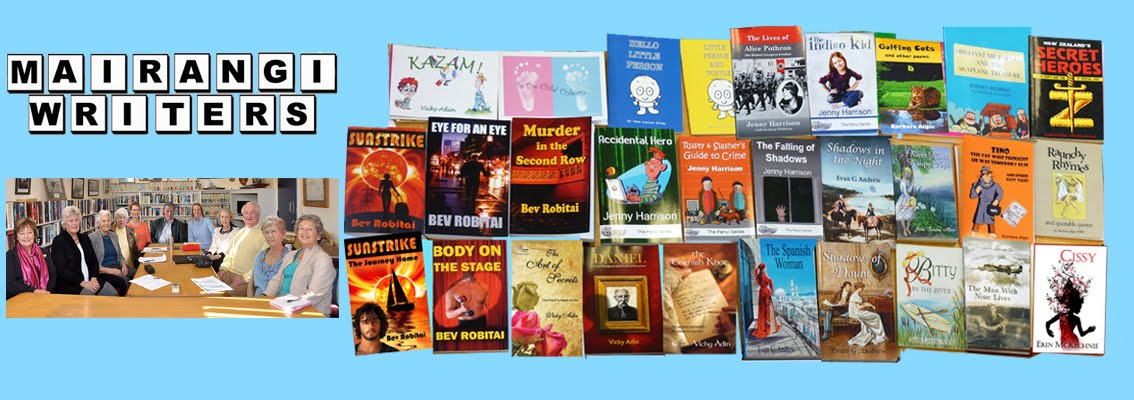
I’m one of a happy bunch of writers called the Mairangi Writers’ Group. We operate in Auckland and have been going for about thirty years. Our members have written and published upwards of thirty books in a variety of genres, from children’s books to non-fiction to chick-ick lit. If you don't know what chick-ick lit is, you’re in for a gory surprise!). We blog, we arrange seminars while still writing prolifically and, at present, are busy organising an all-out book fest for March where we celebrate our prodigious output and our general expertise as writers.

We’re not going to let desertion by the ‘big boys’ stop good New Zealand books from getting to readers. No way!

Jenny Harrison