Hands up now! How many of you have read, How to be a Woman by Caitlin Moran? Yes, I realise it was published
four years ago, but you have to understand I’m the one who’s always tagging
along at the end.
If you want a totally refreshing look on life through the eyes of
English woman C. Moran then, it’s all here. In among the belly laughs are words
of great wisdom for women, possibly men too. You may have to put the laughs on
hold for a while, but the wisdom is certainly there.
I’ve also learned that Caitlin has a number of male admirers of her
revelations about women. God help us if they ever act upon some of them!
Another thing you’ll discover is the high percentage of woman-kind
who can knowledgeably pat her on the back for some of her insights. Over the
years we may have buried those thoughts as bizarre but now we learn most of the
female gender are just as crazy as we’ve always thought ourselves. Well, not me
personally of course, but heaps of others!
Look at the chapter headings…
I become Furry, What to
call my Breasts? I Need a Bra, I am Fat, I Go Lap-Dancing, I get into Fashion, to
mention but a few.
This is a whole hand-book on how to face the world from the age of
13. In between the unrestrained laughter one finds such paraphrased gems as the
over-sized breasts of a desperately running girl calling out, ‘Just go on
without me, I’ve had a good life.’
It seems to me, we are sadly lacking in books written with a
delightfully fresh slant, filled with humour and dare I say it, written by
women. This is a dandy; try it for your summer reading.
Pam Laird
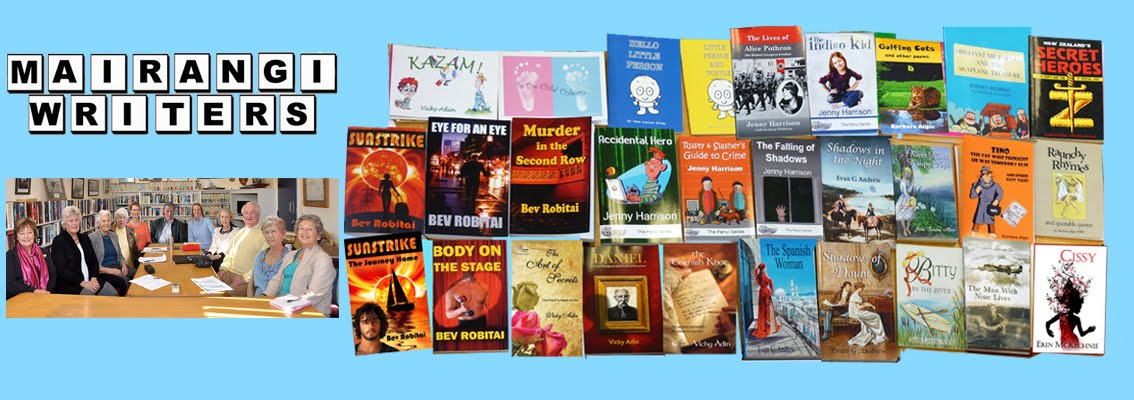
Mairangi Writers' musings on writing and publishing.
Friday, 3 April 2015

Friday, 27 March 2015
Life Begins at 40? Monique Constable says YES!
According to a post I read on Facebook during the week, I am
in my ‘Midlife’. In a matter-of-fact way
the page stated, ‘Now is the time to grieve the loss of any unrealized dreams
from the past and prepare your body for the next stage of life’. Sigh….at 42, true, I’m no longer a spring
chicken, though I admit I was disturbed at the implication that it was time in
my life to change down a gear.
Given the opportunity to be 20 again, I would study
journalism and make a profession out of creating art though literacy. How fabulous to have the creativity and depth
that are assumed character traits of the masters of the written word, synonymous
with my identity! Certainly being
formally recognised as a Writer would have changed the way I was perceived, the
people I would meet, and the relationships that I entered into, wouldn't it?
Pre-40, I wish I had loved myself more: my looks, my weight,
my attitudes, my flaws, my quirks…..all of it!
I wish I had been able to articulate what I felt in a heartfelt way, and
made myself more vulnerable. I would
listen to my gut instinct and not be so influenced by anyone else…….Maybe with
the exception of my parents, who were, dare I admit it, usually right! I would have put more energy into productive
endeavours, rather than the angst I put into my love life or what I should
wear.
Upon reaching my 40th birthday, differing from the opening
statement on ‘Midlife’, I decided that it wasn’t too late to give myself the opportunities
I didn’t have in my youth…..the things I spent my 20’s assuming I would do,
then my 30’s feeling resentful that I hadn’t done. I stepped forwards into the unexplored terrain
I had buzzing inside my mind and joined Mairangi Writers Group.
So, new to micro-managing the words I opt for, the skills I
have acquired through collaborating with an exceptionally talented group of
writers has had vast implication on the way I communicate. These days, I analyse the outcome of the
words I choose prior to using them and I think twice about the construction of
even the most casual texts or emails. An
unfortunate side effect for friends and family is that I find myself in the
irritating habit of replacing the words they use with ones I deem more
descriptive and appropriate, and sometimes I find myself finishing their
sentences when they pause in search of the perfect word.
So midlife - pfffffff….I believe I am in my prime, in pursuit
of life rather than letting go of unrealised dreams! Now instead of thinking ‘Life begins at 40’
are the lyrics to a very cheesy 80’s song, I see how profound the person who
coined that saying really was! – Sage-like!
Monique
Friday, 20 March 2015
Maureen Green's 'Lightweight Heroes'
In my research, to
find and bring to attention the purpose of mythology, I have discovered spiders
figure prominently in worldwide Mythology, Legends and Historical events. Timeless
myths and legends are a magic mirror through which the hopes and fears of
people from the earliest time may be viewed. Yet, eyes often cloud when I
mention spiders and, "Can't stand spiders," permeates the air. This reaction
may stem from the Christian belief that spiders represent human fragility and
the enticement of evil. But in many cultures, spiders are viewed as
heroes. According to German folklore, Spider, recognizing the birth of Christ
as glorious, spun silver and gold webs on trees. Throughout Africa ,
Spider is either a trickster or a great god. Japanese believe Spider Woman
ensnares careless travellers, the Pueblo
Nation of America that Spider Woman created the universe. The Greeks and Norse
thought of spiders as weavers of peoples' fates.
From myths gleaned
from the past, a number so old they were recounted before the advent of the
written word, I have selected spider stories that show how spiders influenced
mankind. The work, Lightweight Heroes, to be published this year, retells of
ancient stories.
Here's a taste to
whet the appetite.
The Story Bringer
African
Story Retold
Long before
writing was invented story telling became a lost art. Displeased with mankind,
Nyame, the Sky God, took away the stories and locked them a box. Anansi,
saddened by what he saw turned to his wife.
"Look, Aso,
look at the people's faces. They work all day and are lost without their
stories to tell at night."
"So, so
sad," Aso said. "Many have tried to persuade Nyame to give them back,
but he just laughs in their faces."
"People want
to make sense of their world. They need their stories, Aso. I'll go and ask father the free
them."
"But… "
Anansi looked to
the heavens. "Yes. I know it was he who turned me into a spider and
banished me to Earth, but I have to do this."
Straight away he
climbed to the highest point in the tree he called home, teased out a sticky
thread and began to build a staircase to heaven. Higher and higher he inched to
his former home in the sky. Finally he stood before his father.
A frown creasing
his brow, Nyame looked down on his son. "I did not summon you. Why are you
here?"
"I came to
ask for the people's stories."
"What! You
want the stories?"
His derisive
laughter ringing throughout the heavens, the wind blew harder, feathery clouds
scudded across the sky faster and the sun hid in thunderheads. "Many have
tried to get them back but have failed. Why should I unlock the stories for
you?"
"Without
their story telling the people on Earth are sad. They work hard all day, have
nothing to share at night and have no way of making sense of their world."
"And that is
how they will stay."
"What will it take, Father, for you to
give back the stories?"
An expression of
surprise flittered across Nyame's face. "You, you little thing. You could
not pay the price."
"I may be
small, but I am willing to do whatever it is you wish to win back the stories
for the people."
"Whatever I
wish?" A malevolent chuckle burst from Nyame's lips before he said,
"you'll have to bring me four rare fierce animals."
No fear showing,
Anansi looked his father in the eyes, "And they are?"
"A snake that
swallows animals whole. A leopard with sharp teeth like spears. A hornet that
stings people and Mmoatia, the invisible fairy. Bring all of these to me and
I'll give you the stories."
"Then it
shall be so."
His father's face
broke into a broad smile and amidst raucous laughter that reverberated through
heaven and Earth Anansi began to climb down wondering how he was to capture the
creatures Nyame desired.
"Well?"
Aso asked when he reached his web.
"Little
change in father's mind, but he did set me a challenge."
His story told, he
looked to Aso. "How I am going to do these things I cannot think."
Aso stroked one
foreleg along the other while she thought. "The snake first. Take a good
long thick branch and some strong vines to the river where the snake
lives," then she whispered in Anansi's ear in case Nyame was listening.
Using magic powers
retained when his father changed him into a spider Anansi grew to gigantic
proportions. Armed with a stout branch he made his way to the river mumbling,
"This one's longer than he is. No. It's not. Yes, it is. No, its
not."
"Yoh there,
Anansi," snake called as he emerged from the water. "What's all the
mumbling?"
"Aso and I
are arguing about how long you are."
Snake wound its
way closer.
Anansi held out
the branch. "She says you are longer than this. I think not."
"I'm a huge
snake, much longer than that stick you hold. Here, put it next to me. I'll
straighten out and you measure."
Anansi lay the
branch on the ground and snake glided along its length.
"You've still
got kinks," Anansi called. "I'll tie you along the branch and then
we'll have a true measure."
"Right,"
snake said.
In a flash Anansi
secured him with to the branch with vines and took him to heaven.
His face showing
no emotion, "Leopard, hornet, the fairy. Where are they?" Nyame said
as he looked along the length of the snake.
No further words
forthcoming, Anansi rappelled back to Aso.
"Well,"
she again asked on his return.
"Father was
not amused, he just said, leopard, hornets, the fairy. Where are they? How on
earth do I capture a leopard?"
Aso thought for a
while. "Go dig a big hole." She leaned in and whispered the rest of
her plan in his ear.
Straight away,
Anansi assumed a super size, dug then covered a deep hole with branches before
returning home. Next morning a leopard lay in the pit.
"Here you
must be tired from trying to get out," Anansi called as he lowered himself
down. "Let me help you."
As soon as the
leopard was close enough, he tied it to long sticks with his sticky thread and
whisked him to heaven.
A stone-faced
Nyame looked at the leopard and then to his son. "Two," was all that
he said.
"I'll
return," Anansi called from over his shoulder and slid down to Earth.
"The hornets
and the invisible fairy, Aso, how do I capture them?" and listened
intently to her plan.
Armed with a gourd
full of water Anansi went to a tree where hornets buzzed around the hive
entrance. He watched for a while before pouring water over the hive then he cut a leaf from a
banana tree, held it over his head and poured the rest of the water over
himself.
"Hey
hornets," he called. "It is raining. Your hive is wet. Come shelter
in my dry gourd."
The hornets busily
shaking water from their wings abandoned the hive and flew into the gourd. As
quick as a flash Anansi spun a web to seal the opening. The hornets captured,
he looked to the West where he knew one of the Mmoatia who cared about people
dwelt. The final task to complete he climbed to the top of the hornet's tree,
launched and silken thread tracking behind, floated on the wind until he
reached the Mmoatia tree.
"Mmoatia,"
he called.
"Who
calls?"
"Anansi, son
of Nyame."
Suddenly a small
black, red and white creature less than thirty centimetre tall, its feet
pointing backwards appeared. "What do you want?"
"Help. Help
me get back the people's stories from my father."
"All who have
tried have failed."
"Together we
can succeed."
The fairy just
stared, continued staring at Anansi until he added, "Father set me a
challenge. He agreed to give the people back their stories if I complete four
tasks. Three have been completed."
"And the last
one is?"
"Bring him an
invisible fairy."
"What!"
The Mmoatia disappeared, reappeared in the highest branch of the tree and
called, "You want me to…" as she slowly descended to stand in front
of Anansi.
"Why
me?"
"You care
about the people. We could…"
The plan
explained, the fairy blanked out for what seemed to Anansi, a life time before
reappearing.
"Right then," she said. "Let's do it for the
people"
Hornet nest held
tightly, Anansi and the invisible fairy climbed to heaven.
The smile on
Nyame's face disappeared when his son greeted him.
"The tasks
are complete, father, I've brought you the hornets nest and the Mmoatia.
Release the stories."
"I see no
fairy."
No sooner had the
words left Nyame's mouth than he cried, "Owww! Ouch!
"Do you feel
the Mmoatia, father?"
"The pain's
nothing other than my bones creaking."
Air suddenly
whooshed from his throat and he doubled over."
"You feel
Mmoatia's presence now, father?"
"Yes,
yes," he croaked.
"Then release
the stories."
The lock, corroded
by time, creaked open. Out spurted thousands of ancient stories. For a while
they floated on the air before raining down on Earth.
Anansi and Mmoatia
looked down on the village. Smiles on every face, the people gathered before
Hene Mojo, the oldest and wisest of all the villagers. His mind filled with
long forgotten and new stories, his gaze touched every face before he perched
on the ancient stump where storytellers of the past had sat.
His eyes lingered
on the hushed gathering before he said, "Long before writing was invented
all of our stories were locked away by Nyame the Sky God."
Gasps filled the
air.
"Let me tell
you how Anansi the Spider and a Mmoatia made him give us back our stories.
Maureen Green
Friday, 13 March 2015
Mairangi Writers Seminar 2015
It's with great excitement that we're putting the latest touches to our latest seminar, aimed at indie writers who have published or are completing books and are wondering how to get them disseminated into the wider world beyond friends and family. Distribution is the biggest stumbling block in the way of reaching readers, but times are a-changing so we've called on some of those in the industry to give us some hints.
We'll have the acquisitions team from Auckland Libraries, a book buyer for bookstores, a couple of bookstore owners, and representation from the NZ Society of Authors. They should be able to answer some pertinent questions about how to get indie books into libraries and shops!
The seminar is open to all, with a $5 entry fee. There will be tea, coffee and nibbles at half time. Kick-off is at 10am, this MONDAY 16 MARCH, upstairs at the Browns Bay RSA.
We look forward to meeting more local writers and sharing useful information as widely as possible.
Hope to see you there!
Bev Robitai
(Now we just have to cross fingers that Cyclone Pam doesn't blow the East Coast off the map over the weekend!)
We'll have the acquisitions team from Auckland Libraries, a book buyer for bookstores, a couple of bookstore owners, and representation from the NZ Society of Authors. They should be able to answer some pertinent questions about how to get indie books into libraries and shops!
The seminar is open to all, with a $5 entry fee. There will be tea, coffee and nibbles at half time. Kick-off is at 10am, this MONDAY 16 MARCH, upstairs at the Browns Bay RSA.
We look forward to meeting more local writers and sharing useful information as widely as possible.
Hope to see you there!
Bev Robitai
(Now we just have to cross fingers that Cyclone Pam doesn't blow the East Coast off the map over the weekend!)
Sunday, 8 March 2015
Author Interview with Paul Denny
Another in our series of interviews with members of Mairangi Writers. Paul is one of our newer members and is keeping us entertained at meetings by reading (in a delightful rich brown voice) the latest section of his memoirs. Here's Paul...
What inspires you to get out of bed each day?
I’m an early riser – I walk five kilometres each morning
before seven. After breakfast, I have been working on my first book, which is
currently being edited. I am presently completing an online course with Yale
University entitled; Moral Foundations of Politics. I am an avid reader, and
spend the early afternoon indulging in my latest acquisition. There never seem
to be enough hours in the day. How did I manage when I was working fulltime?
What is your favourite book from childhood? Tell me about it.
“Moonfleet” by J. Meade Falkner. The novel is set in the 18th
century, and written in the 19th. The theme explores a young
teenage boy growing up with his aunt in a small village on the Dorset coast in
England. The central character is John Trenchard, and the narrative explores
his coming of age and the transition from boyhood to adulthood. John learns
many of the men in the village are smugglers. The story weaves between England
and Holland. A boyhood romance weaves its thread through the story. I first
read the book when I was fourteen. It had a lasting impression on me. In
particular I found the story compelling, and the beautiful prose carries the
novel to its romantic conclusion.
What are you currently reading? Tell me about it.
“The Long Road to the Deep North” by Richard Flanagan. I
finished the book last week. The story is centred on an Australian surgeon,
Dorrigo Evans, who is conscripted to South East Asia during World War 11. He is
captured by the Japanese, and ends up commanding a group of fellow soldiers who
are forced to labour in constructing the Thai-Burma railway.
Dorrigo is haunted by a love affair he had with his uncle’s
attractive wife two years before in Australia. In his position within the
confines of the Japanese prisoner of war camp he experiences the tension
between love and hatred, life and death. On day his lover sends a letter to
him; it will change his life.
This beautifully written novel celebrates the human spirit,
and what it is capable of enduring under extreme hardship. The physical and
mental cruelty inflicted on the prisoners is harrowing, yet the novel keeps the
reader engaged to the end. Definitely one of the most memorable books I have
read over the last twelve months.
Do you remember the first story you ever wrote? Why does it
stick in your memory?
Not really. Writing is a hobby I have found time to indulge
in, following a busy work career.
What’s the best thing about being a writer?
Complete freedom and the joy of personal reflection. To be
able to construct an idea or a memory from the past and give it shape is so
rewarding. I’d always wanted to write for pleasure. My first book has taken me
a year to finish. The journey is almost complete. A change of genre from
non-fiction to a novel is currently occupying my mind.
What is your writing process?
Map out a basic story book in my mind. The detail comes from
research, and as each chapter is constructed I have tried in my first book to
engage the reader, without giving away the ending. I found writing for three to
four hours on weekdays has been engaging; where did the hours go to?
Rewriting was a discipline I spent considerable time working
on. As each chapter was completed I would then redraft again before moving to
the next one. Once the manuscript was completed I then revised each chapter
again three times over. The forth draft will comprise amendments from the
editing process.
When you're not writing, how do you spend your time?
Reading fiction, nonfiction, and surfing newspapers online. I
would spend an hour each day on the web reading articles from the BBC and The
Guardian. I enjoy eating out with my wife, often accompanied with friends. We
both enjoy spicy food; Indian and Thai would be our favourite cuisine. Our five
grandchildren take a lot of our attention and time.
What are you currently working on? Explain.
I have completed my first book, a memoir about adoption and
identity. The manuscript is currently being edited. From that process I intend
to make alterations to the text and then publish the work during 2015.
List of Books by this author: “Searching for Enda: A Memoir
on Adoption and Identity”.
Contact: email pauldenny@xtra.co.nz
Friday, 27 February 2015
Evan Andrew on 'Catton-gate' and Harper Lee's latest.
While our lovely hot summer rolls on, I am about to take
a break and head away to the Coromandel for a few weeks' holiday. As I write this, there has been plenty of media news recently regarding authors and their
books, or perhaps books and their authors.
Catton-gate is still raging as I write, with letters to the editor, journalists and radio talk-back hosts all having their opinion on the media frenzy of what she said, or how it has been interpreted, with everyone from fellow authors, book judges, and politicians all wading into the fray.
Sadly, it appears to come across as petulance that she wasn't awarded NZ's top prize, whatever that was, or may mean as far as the general public is concerned. For her book sales are still climbing, and a reprint is happening. Lucky girl!
Is it really her book, or a plant, or just an unedited manuscript?
How could Harpers, (her publishers,) have ever lost a second book, by their best selling author? This is of course a publicist's dream, and whatever happens, the book when released will make someone a fortune. The whole world will follow this with interest. Did she, or didn't she?That is the question.
The chances are, we may never know the true answer.
Catton-gate is still raging as I write, with letters to the editor, journalists and radio talk-back hosts all having their opinion on the media frenzy of what she said, or how it has been interpreted, with everyone from fellow authors, book judges, and politicians all wading into the fray.
Sadly, it appears to come across as petulance that she wasn't awarded NZ's top prize, whatever that was, or may mean as far as the general public is concerned. For her book sales are still climbing, and a reprint is happening. Lucky girl!
Meanwhile, there is all the brou-ha over the announcement
of frail, reclusive, eighty-eight year old Harper Lee's newly found second
book, 'Go Set A Watchman.'
This has all the ingredients for what will become another
book, Hollywood film, TV show, stage play, and so on, which I am quite sure
will happen.Is it really her book, or a plant, or just an unedited manuscript?
How could Harpers, (her publishers,) have ever lost a second book, by their best selling author? This is of course a publicist's dream, and whatever happens, the book when released will make someone a fortune. The whole world will follow this with interest. Did she, or didn't she?That is the question.
The chances are, we may never know the true answer.
Evan G Andrew
Friday, 20 February 2015
Author Interview with Jenny Harrison
The first in our series of Author Interviews where NZ Indie writers explain their writing lives.
What inspires you to get out of bed each day? Coffee! No, really. The rich aroma of good coffee and I’m out of bed in a flash. Otherwise I tend to drift on in a dreamy state doing nothing, thinking nothing. In any event I’m pretty dozy until about 10 o’clock. But coffee helps.
What is your favourite book from childhood? Tell me about it. My favourite children’s book has to be Wind in the Willows. Such a tender book filled with gentle stories of friendship and adventure. Written by Kenneth Grahame, illustrated by E H Shepard and published in 1908, this book is timeless, a long-gone pastoral England with characters one comes to love; Mole, Rat and the irrepressible, conceited Mr Toad.
What are you currently reading? Tell me about it. I’m not a book snob. I haven’t read The Luminaries and probably won’t. My research at the moment is sombre; the Holocaust, so I need light reading to centre me. I have belatedly found Susan Hill’s crime novels, a nice balance of whodunit with complex inviting characters. Her ghost stories are excellent too and, I suspect, will become the inspiration for my own paranormal stories. There are no vampires or zombies. No one’s scared of those! They don’t make you look over your shoulder or double-lock your door at night. But a subtle story; a ghostly hand clutching yours, an indent on the bed when you know you’re alone, a shadow across the windowsill – now that’s the stuff of real fear.
Do you remember the first story you ever wrote? Why does it stick in your memory? The first story I wrote was a book, Debbie’s Story. It was a bestseller and that’s probably why I remember it. It was a biography of childhood sexual abuse and it came out at just the right time and right place for a dialogue to begin about what some children are put through by evil adults. Radio, television, magazine and newspaper reviews – all heady stuff. I wondered if writing and publishing was always going to be that easy. I came down with a crash.
What’s the best thing about being a writer? Ian Rankin said; ‘I think most writers are just kids who refuse to grow up. We’re still playing imaginary games with our imaginary friends’. Bam! Kerplat! Take that, you scoundrel! Saddle up, Tonto, we’re outta here! It’s wonderful to create characters and to live with them for as long as it takes to complete the book. There is a kind of childlike pretension about writing and about slipping into the ‘skin’ of someone else, even if that someone is made up.
What is your writing process? I try to write for at least an hour a day and I keep a record of the number of words I manage in a writing session. Sometimes it’s a thousand and that feels very good. Sometimes it’s only a page – not so good. I don’t have any superstitions about writing, although if have a little stuffed frog on the computer whose black eyes stare at me and remind me to ‘get going, already’.
When you're not writing, how do you spend your time? I read a lot and I play classical guitar. I’m not only a double dipper (two books going at a time), I usually triple-dip, meaning that I will have one non-fiction book I’m reading for research and then two, at least two, novels. I might even have a ‘how-to’ book on the sidelines, something like Solutions for Writers by Sol Stein or Plot by Ansen Dibell, two oldies but greaties. When I get stuck those sorts of books become my butt-kickers.
What are you currently working on? Explain. At the moment I’m researching a book on the Holocaust. Jewish friends of mine lost their entire family, except one, in the Holocaust. All they had was a bunch of letters written in Polish. A good friend translated the letters and slowly a tragic picture is emerging. I’m hoping to have a first draft by the middle of the year (2015 that is!). We would like to call it Out of Poland : when surviving is the best revenge.
What inspires you to get out of bed each day? Coffee! No, really. The rich aroma of good coffee and I’m out of bed in a flash. Otherwise I tend to drift on in a dreamy state doing nothing, thinking nothing. In any event I’m pretty dozy until about 10 o’clock. But coffee helps.
What is your favourite book from childhood? Tell me about it. My favourite children’s book has to be Wind in the Willows. Such a tender book filled with gentle stories of friendship and adventure. Written by Kenneth Grahame, illustrated by E H Shepard and published in 1908, this book is timeless, a long-gone pastoral England with characters one comes to love; Mole, Rat and the irrepressible, conceited Mr Toad.
What are you currently reading? Tell me about it. I’m not a book snob. I haven’t read The Luminaries and probably won’t. My research at the moment is sombre; the Holocaust, so I need light reading to centre me. I have belatedly found Susan Hill’s crime novels, a nice balance of whodunit with complex inviting characters. Her ghost stories are excellent too and, I suspect, will become the inspiration for my own paranormal stories. There are no vampires or zombies. No one’s scared of those! They don’t make you look over your shoulder or double-lock your door at night. But a subtle story; a ghostly hand clutching yours, an indent on the bed when you know you’re alone, a shadow across the windowsill – now that’s the stuff of real fear.
Do you remember the first story you ever wrote? Why does it stick in your memory? The first story I wrote was a book, Debbie’s Story. It was a bestseller and that’s probably why I remember it. It was a biography of childhood sexual abuse and it came out at just the right time and right place for a dialogue to begin about what some children are put through by evil adults. Radio, television, magazine and newspaper reviews – all heady stuff. I wondered if writing and publishing was always going to be that easy. I came down with a crash.
What’s the best thing about being a writer? Ian Rankin said; ‘I think most writers are just kids who refuse to grow up. We’re still playing imaginary games with our imaginary friends’. Bam! Kerplat! Take that, you scoundrel! Saddle up, Tonto, we’re outta here! It’s wonderful to create characters and to live with them for as long as it takes to complete the book. There is a kind of childlike pretension about writing and about slipping into the ‘skin’ of someone else, even if that someone is made up.
What is your writing process? I try to write for at least an hour a day and I keep a record of the number of words I manage in a writing session. Sometimes it’s a thousand and that feels very good. Sometimes it’s only a page – not so good. I don’t have any superstitions about writing, although if have a little stuffed frog on the computer whose black eyes stare at me and remind me to ‘get going, already’.
When you're not writing, how do you spend your time? I read a lot and I play classical guitar. I’m not only a double dipper (two books going at a time), I usually triple-dip, meaning that I will have one non-fiction book I’m reading for research and then two, at least two, novels. I might even have a ‘how-to’ book on the sidelines, something like Solutions for Writers by Sol Stein or Plot by Ansen Dibell, two oldies but greaties. When I get stuck those sorts of books become my butt-kickers.
What are you currently working on? Explain. At the moment I’m researching a book on the Holocaust. Jewish friends of mine lost their entire family, except one, in the Holocaust. All they had was a bunch of letters written in Polish. A good friend translated the letters and slowly a tragic picture is emerging. I’m hoping to have a first draft by the middle of the year (2015 that is!). We would like to call it Out of Poland : when surviving is the best revenge.
Do you belong to a group? About thirteen
years ago I joined a fabulous group of writers. The Mariangi Writers Group in
Auckland has been going for about thirty-five years and is a powerhouse of
inspiration and encouragement. Every writer needs a group where they can throw
ideas around, get good critique and have understanding friends. MWG has been
that for me.
List of Books by this author:
List of Books by this author:
Nonfiction:
Debbie’s Story
A New Life in New Zealand
To the Child Unborn
The Lives of Alice Pothron
Fiction:
The Falling of Shadows
The Indigo Kid
Accidental Hero
Rusty and Slasher’s Guide to Crime
Rusty and Slasher and the Circus
from Hell
Thanks Jenny for kicking off our introduction to the members of Mairangi Writers - such a varied bunch!
Subscribe to:
Posts (Atom)