Search This Blog

Monday, 26 January 2015

Jenny Harrison on why you should read REAL books!


I read recently of the damage that can occur while reading in bed. Not the normal holding a book at something like eye level with a bedside lamp of low wattage next to your pillow, but using an ebook in bed. Seems that the light emanating from backlit e-readers affects the body’s circadian rhythms and, as a consequence, it will take you longer to fall asleep resulting in lower morning alertness. All this from researchers at the Brigham and Women’s Hospital in Boston and they’re the experts.
Apparently it has something to do with blue light or short-wavelength-enriched light from things like phones and iPads which reduces levels of melatonin. And of course, we all know that melatonin has a role to play in inducing sleep.
Melatonin, or more popularly known as N-acetyl-5-methoxytryptamine, is a hormone found in animals, plants, fungi and bacteria. It is synthesized in animal cells directly from the amino acid tryptophan. Besides its function as synchronizer of the biological clock, melatonin is a powerful free-radical scavenger and wide-spectrum antioxidant as discovered in 1993 (Wikipedia). By reading in bed using an iPad you could be compromising those scavengers!

But you knew that, didn’t you!
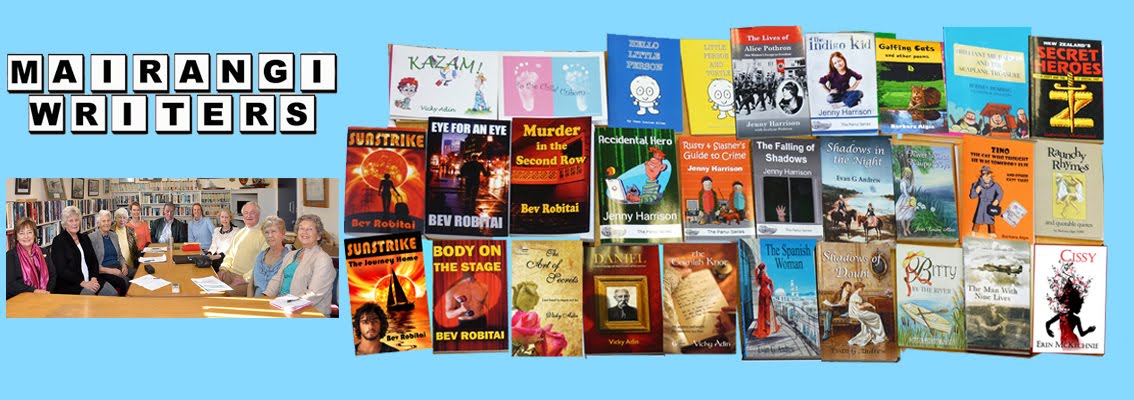
So, it isn’t the ghoulishness of the latest Maureen Green book or the hilarious antics of Rusty and Slasher Naills in the Panui series, or the sweet lyricism of Jean Allen’s River books or the nail biting will-he-make-it-home of Bev’s Robitai’s latest Sunstrike novel (all these books are available at letsbuybooks) keeping you awake at night. There’s a much more prosaic and boring reason.
But you knew that too, didn’t you!


J
Jenny Harrison
(Mairangi Writers' 'Rural Advisor')

Friday, 16 January 2015

A Short Story from Jean Allen


Hello readers. Despite its title this little story is light and relatable. It is the first draft of a chapter in one of my books and taught me brevity is often best.

Aunty’s Funeral
Already late at two minutes past midday I scream the car uphill and around corners, into the wrong gate of the Crematorium, back out, roar back up the road to the right gate and can’t find a carpark. Finally, I squeeze into an end slot, half on the grass and cut the engine. It starts to rain. Using my purse as a hat I run across the parking lot, take a shortcut through the gardens, rip my pantyhose on a bush and make the porch. My suit is clingingly wet.  
The Minister has beaten me. He’s already at the lectern.  I squelch along the back wall and squeeze into the corner. Hiding and dripping on a Chapel carpet is not a good look but everyone is standing straight and tall and righteous. Good. Now everyone sits down. The place is packed. I know dear old Aunt Madge had been a sweet lady but this number of mourners takes me by surprise. I shrink into the corner. 
 
The Minister adjusts the microphone. “We are here today to pay our respects and our farewells to our dear friend Cecil Bathurst.”


I’m at the wrong funeral and if I try to leave this funeral service now that it’s started I’ll be the cause of a maximum, congregational head turn. I could sprint out. I could shuffle out - or even pass out. I give up and decide to see it out.
   
At twelve-thirty I leave, the last unidentified mourner, sneaking away; but over by the gardens stand the cousins … waiting. There’s no escape.
   
“I tried to stop you going in,” Cousin Stan winks with a wicked grin, “but you did such an amazing sprint over those rose gardens I couldn’t catch you.”


We are all in black according to Aunty Joan’s wishes and we all go in together to sit like ten blackbirds in the two front seas.  Damp but in the mood by now I relax with my family.

This is Jean Angel Allen hoping that whatever the weather your 2015 is happy.


Saturday, 10 January 2015

Guest Post from Mike Crowl, Dunedin writer

This week for our group blog I'm reprinting the best article I've seen on book promotion - something we all need a bit of help with!


Promoting your product
I've been spending a lot of time in the last year promoting my three e-books. It's a tough task but it has to be done. Sometimes it's fun, sometimes it's a chore. You meet interesting people online in the process, and there's always plenty of advice as to how to do it better - too much, perhaps.

But one thing is certain, if you're not a big name and not already a big seller, you're going to have to be patient and let the sales trickle in bit by bit.

I was thinking about this while walking the dog this afternoon. I came across a sign on the roadside which had blown over (not the one in the picture; that's just an example, and doesn't look as if it would blow over easily). It was advertising firewood and so on. I wondered if it would have been anymore effective even if it had been standing up.

Firstly, it was right on the corner of the road that the customer was expected to go up. No warning further down the road, nothing. Just the one sign.

Now this isn't a road where motorists are doing any great speed, but even at 50 kmph, it takes a bit of doing on the motorist's to read the sign, understand it, think about whether he really wants that product, think about whether he really wants to stop or if he's got better things to do; it takes him time to realise the sign relates to the road they're just about to pass, to discuss it all with his wife, to find a way of turning around and then going to investigate. Even if he thinks about all this and decides to come back later, it's possible he'll forget, or find something else more urgent needing to be done.

I know all this because I've often not stopped when going through the orchard area in Roxburgh. At 100 kmph it's even harder to make all these decisions.

At the very least there needs to be two or three signs further down the road at considerable intervals (and yes, I understand that's all a cost to the seller), each one pointing to the road that's coming up, and giving the driver plenty of time to consider whether he wants to make the effort of stopping and buying the product.

Without those warning signs, however, it's unlikely anyone will stop, unless they're absolutely desperate for what's on sale.

Now compare this to an author trying to sell his/her book on line. If I post a tweet, or a facebook comment once, and don't bother again, all I've done is announce to a few possible followers that I have a product. Big deal. If they happen to know me, happen to have read my previous books and enjoyed them, then it's vaguely possible they may suddenly decide on the spur of the moment to purchase the latest one.

It's more likely they'll pay no attention at all. In a digital sense, they'll keep driving.

However, if I post tweets at regular but not annoying intervals, and make them different, enticing, and interesting (that is, not just sales blurbs, but like real tweets or comments) then over the course of time, interest will be aroused, and the reader/follower may think: I remember that from a week or two ago. I might be interested.

They may still switch off and go to the next more interesting tweet or pretty picture. But after seeing these tweets/comments several times, couched in creative ways, they may start to say: Yes, I will look into this. They may click on the link, investigate further, check out the sample. They may even buy.

But notice what a long process this is.

This is why advertisers keep on hammering away at us on TV, in the newspapers, online. They know that the first time we won't pay any attention. We might like the ad, if it's clever, but as for the product, we may find we have no use for it, or it doesn't appeal just at that point. But over successive weeks, months and so on, the product starts to click in our memories, and we slowly change our view. We may resist forever - some ads make me resist, though obviously the advertisers don't realise that. Equally, we may finally think: now's the time.

Perseverance, creativity, continual exposure. All keys to telling the world that we authors have got something they'd like to read. Just this week, a person who has their own online app and with whom I've had a lot of contact via email about what he's selling, suddenly announced he'd bought my book. I think the only way he'd have known about it is because it's on the bottom of my emails. And has been for months.
Saturday, 3 January 2015

Kristen Lamb on breaking rules to be creative


This is a guest post borrowed from Kristen Lamb. You can find her blog on the link at the end of this excerpt.

Kristen says “For the past several years, I’ve always begun the New Year with predictions of what the publishing industry would or wouldn’t do in the year to come. But this year? I’m being a rule-breaker and taking a different perspective—one I believe has greater impact and longevity. Algorithms rise and fizzle, publishers go out of business, change paths, or change rules. Heck, Amazon changes its mind more than my mother trying to pick a restaurant. So…eh. Not going there this year.Unlike the days of early artists, we live in a light-speed society where something can fall flat or catch fire in an instant. This is an exciting time to be a writer.

We are in a New Age of the Artisan. When I give advice to young people about a future career, I simply want them to ask these simple questions. Can what I do be outsourced to a low-wage worker in another country? Can it be broken down into a procedure/manual and reproduced? Can it be done by a computer? Can I do/produce something consumers WANT that ONLY I can do, and do it really well?

I believe the future belongs to the artists and the rebels.

So….

Breaking rules. We all want to do it and, to be blunt, we should. I’ve dedicated most of the craft posts on this blog to teaching fundamentals, why they are important. If we don’t understand the rules, then we aren’t taking our profession seriously.

We can be Rebels with a Cause or Rebels Without a Clue ;) .

First, to be a really GOOD rebel, it helps to study successful rebellions of the past. This is all highly redacted because this is a BLOG, but I hope it will educate and inspire you…”

[Read the rest of the article here – it’s well worth a look to inform and inspire your writing for the coming year. Ed.]

Happy New Year and good luck with your writing for 2015. Let's see if we can top last year's total!
Bev

Friday, 19 December 2014

Joanna Penn and Booktrack in Auckland this week.

A large group of indie authors gathered to hear UK writer and entrepreneur Joanna Penn speak at the Auckland Central Library this week. The event started out as Joanna emailing a few writers to see if we'd like to meet for a coffee when she visited Auckland, but the burgeoning writerly grapevine sprang into such vigorous life that over a hundred replied! The result was a two-hour talk and Q&A session sponsored by Booktrack that brought together a whole heap of local authors who hadn't met before.
You can see the content of the talk here on Joanna's website, and you can find out about Booktrack here. It's a site that allows you to add background music and subtle sound effects to deepen the reader's immersion in your ebook.
But perhaps the most useful outcome was finding another place where local writers can meet up to share advice and information in this fast-changing business of ours, by joining the New Zealand Indie Authors Facebook Page:  (Note that you will need to ask to join the group)
I see this as a huge step forward in gaining the notice of book sellers and libraries. United we stand and all that! And the author community is full of such amazing and talented people that great things will come from letting them interact.
I'm excited to see what 2015 will bring!
Wishing everyone a safe and happy Christmas and (dare I ask) a prosperous New Year!
Best wishes,
Bev


Friday, 12 December 2014

Erin McKechnie on giving birth to a new book


The Christening
Most of you will know that I self published my first novel ‘Cissy’ in the middle of the year. Maybe with your first book you indulged in the same feelings I did: an incredible, overwhelming feeling of awe and wonder at your own magnificence as you stroked for the first time that glossily covered, exquisitely designed and presented work of art. Cissy’s arrival meant the world will never be the same again.
Do you remember how slow and painful the passage was for this delicate embryo of the heart and mind? For me and Cissy the journey posed challenges of the most personal nature. As she grew, I dithered, beset with doubt; should I express what we wanted to say so bluntly, expose my feelings and be vulnerable to ridicule or rejection? The potential to be misunderstood was enormous.  If I was more restrained, would the immediacy and honesty be lost, would readers have any awareness of the complex dynamics in play which created Cissy’s environment?
Along the way Cissy, encased in the cloth of golden prose I had created for her, was sent out into the world to be edited. It was a cold, harsh experience. The first editor didn’t like the book, said it was far too explicit. Demoralised, feeling small and that Cissy was tarnished, I revised many of the passages so that they were less likely to offend the sensibilities of her potential readership. In the process Cissy became a tame and inhibited version of the real thing, lacking frankness and vitality.
A couple of beta-readers gave Cissy and me a shot in the arm, kind and encouraging in their acceptance of her for what she was, a beginner feeling her way in the world, but with good bones. I felt stronger as I sent her out to meet her second editor, the cloth of golden possibility restored from around her ankles to drape gracefully across her shoulders.  Although the second editor liked her well enough she thought Cissy lacked detail.  The subtle references to passionate interludes and flaming exchanges were not explicit enough, she wanted specifics. In short, her opinion was completely the reverse of the first editor.
And so I learned a valuable lesson:  ultimately I must hold onto my own  voice, I must send my darlings out into the world wrapped in the best cloth of gold I can give them, and editors’ opinions are just that, they are not the word of God.
And then that magical moment, when the first beautiful books arrived on my doorstep at seven o’clock in the morning. The tea and toast went cold as I mooned over those gleaming manifestations of the most creative achievement of my life. Maybe you more experienced writers with numerous titles sustaining your sense of well being no longer feel as I did then, but I admit freely, the satisfaction I feel whenever I look at a copy of Cissy is as rich as it was that first winter morning.
It was not enough. Cissy had not been presented to the world, was not Known. I felt bereft; as if one of my precious children, created with so much of my own life force, deserving of acknowledgement, was being ignored. Circumstances precluded having a launch at the time the first books arrived and as time went by it seemed that Cissy might miss out. But – last week I passed through the last rite of passage for a new book – the Launch. Once again others expressed their opinion, pointing out launches are a waste of money and sales don’t compensate for the outlay. They didn’t understand, did they? A launch is not a money making venture. This was a celebration of the transition of this work of art from being a dream in my mind to being a tangible entity ready to go out into the world and create a life of its own. 
I see this book as being rich with promise, blessed with the love and good wishes of all those who attended the launch, as a baby is by those who attend a christening. Finally, unequivocally, it is real.

 Erin

Friday, 5 December 2014

Randy Ingermanson (The Snowflake Guy) shows how to plan your year.


Organization: Make Your Annual Plan Now


Nothing is more important to your writing business than making an annual plan.

 
Even if you don’t follow it completely. (You won’t.)


Even if your year takes a drastic left turn. (It will.)


Even if you bite off way more than you can chew. (You greedy dog, you.)


Those pesky motivational geeks constantly tell us that “if you don’t have a target, you’ll never hit it.” It’s a platitude, but they’re right, curse them.


It may take you five years to do all the stuff you foolishly cram into your annual plan. That can be frustrating, but so what? Life is full of frustrations, and then you die. Being frustrated is better than dying, so don’t sweat the frustrations.


First Things First


There’s one thing you should do before you make that annual plan for next year. Haul out the one you made last year (if you made it), and look at it. Read the whole thing. 


What went right for you this past year? Was that part of the plan, or was it one of those serendipity things that fell into your path? 


What went wrong? Was that something you could have predicted, or did it just come out of left field?


Did you achieve everything in last year’s plan? If so, then bravo. If not, then you may have aimed too high. That’s not so tragic. Aiming high is a good thing.


Did you make a reasonable effort to execute your plan? How many hours did you actually put in? (If you don’t know, then now would be a good time to set up some kind of tool to track your hours. A lot of writers use a spreadsheet, and that works pretty well. I use an online tool at HarvestApp.com that makes it easy to track my time and pay myself an hourly wage for every different kind of task. This costs me $9/month, but I think it’s well worth it.)


Looking back at 2014, I see that I only accomplished a small fraction of the things in my plan. But they were the right things. I edited and rereleased three books from my backlist and wrote one new book. As a direct result, my writing revenue for 2014 shot up rather drastically over 2013. I averaged about 90 hours per month on my writing work, which was more than I averaged at my day job. 


I’d rate the year a success, even though I only completed 4 of the 14 items on my list. The important thing is that I worked hard and felt happy working on the projects I chose. It’s a bonus that my revenue took a leap upward.


One Thing to Remember


Bear in mind that there are things you have control over and things you don’t.


You can’t control whether some publisher somewhere decides to buy your work. (This is why indie authors like being indie—they don’t have to depend on what a publishing committee decides.)


You can’t control how many people are going to buy your book.


You can’t control sickness, family problems, and all the random stuff that happens to you.


You can control (mostly) how many hours you put into your writing. 


You can control what projects you work on. 


You can control what sort of marketing plan you make and whether you execute it. 


Now Make Your Plan For Next Year


Let’s keep this simple and shoot for the sure thing first. Write down the answers to the following questions:


  1. What’s the one fantastic thing you’d like to achieve next year that’s actually in your control? 
  2. What sort of outcome do you expect from it? (That is, will it likely earn you money and if so, what’s a reasonable amount to expect? It’s okay to guess here.)
  3. How much time and money will it reasonably cost you to achieve this goal?
  4. Do you actually have that much time and money available in the year? If you have time and money left over, then go ahead and repeat the above questions as many times as you want, until you’ve run out of time or money to execute them all.

That’s your annual plan for the year, in a nutshell. It won’t hurt to write it up in a document. It won’t hurt to put your major goals on a sheet of paper and post them over your computer, so you see them every day.


I did the above steps just now and immediately saw that I was hoping to do far more than is humanly possible next year. I can’t do ten major projects next year. I can do two. 


I also realized that my #2 project has a predicted return on investment that’s massively higher than the ROI for my #1 project. 


So I’m rethinking things to move the bigger revenue-generator closer to the beginning of the year. Money is time. The more money you earn, the more time you free up to do what you love doing most. 


In 2015, track your progress and review it monthly. Are you putting in as much time as you thought you would? Are things taking longer than expected? 


If you do your annual plan now, well before the New Year begins, you can hit the ground running on January 1. And have a great year.


This article is reprinted by permission of the author. You can read the full piece here.
Award-winning novelist Randy Ingermanson, "the Snowflake Guy," publishes the free monthly Advanced Fiction Writing E-zine, with more than 10,000 readers. If you want to learn the craft and marketing of fiction, AND make your writing more valuable to editors, AND have FUN doing it, visit www.AdvancedFictionWriting.com.