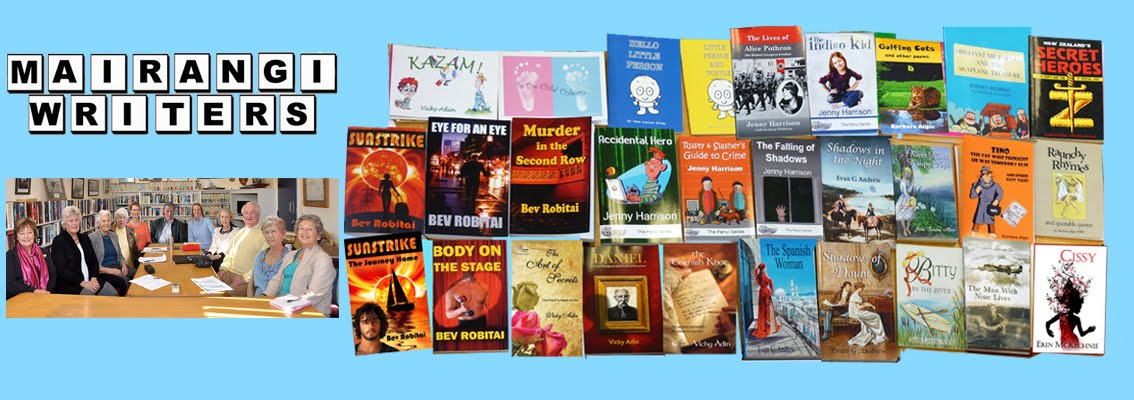
Mairangi Writers' musings on writing and publishing.
Friday, 15 March 2019
Let us Talk of Many Things; of Books and Queens and Pirates, of History and Kings...: A Novel Conversation with Vicky Adin's Gwenna
Let us Talk of Many Things; of Books and Queens and Pirates, of History and Kings...: A Novel Conversation with Vicky Adin's Gwenna: In conjunction with Indie BRAG posted every Friday #IndieBragNovConv T o be a little different from the usual 'meet the au...

Let us Talk of Many Things; of Books and Queens and Pirates, of History and Kings...: A Novel Conversation with Vicky Adin's Gwenna
Let us Talk of Many Things; of Books and Queens and Pirates, of History and Kings...: A Novel Conversation with Vicky Adin's Gwenna: In conjunction with Indie BRAG posted every Friday #IndieBragNovConv T o be a little different from the usual 'meet the au...
Friday, 5 May 2017
How to pick a winning cover!
Here's a really useful post on getting your cover right from a site called Author Author.
"Read this guide before making or choosing your book cover.
"Read this guide before making or choosing your book cover.
"They say 'Don't judge a book by it's cover,' so it doesn't really matter
What complete rubbish! Getting a book cover right is vital because unless it catches the eye of someone looking for a book, they will never read the description, never read a sample and never make a purchase. If you are an indie author your cover will make a huge difference to your sales."
Read the rest of this very useful and very specific post by clicking on this link http://authorbookpromotion.blogspot.co.nz/
I recommend it!
Friday, 21 April 2017
How to Handle Rejection
For those of
us who self-publish (or rather publish independently of the mainstream
publishers) rejection isn’t as much of an issue, at least not at the outset.
For us
rejection comes too late. It comes when our book is published and available
online through websites such as amazon.com or goodreads.com where reviews by
customers can be scathing. What about the buyers, your friends and family, of
your first book who now are strangely reluctant to invest in your second?
For
mainstream authors a rejection letter could be devastating. Jack London
received over six hundred rejections letters but he went on to be the highest
paid writer of his time. In his book On Writing Stephen King writes of
the hundreds of rejection letters he received. He got pretty discouraged bout
that; his short story Carrie was rejected so many times he
finally threw it in the waste bin. Fortunately for him and his thousands of
fans his wife rescued it, persuaded him to turn it into a novel and the rest, as
they say, is history.
For an
independently published writer we have no such discouragement and, on reading
some self-published stuff one can only wish there was someone to pull the plug.
Indies have to be especially careful and the best way to avoid the
embarrassment of a badly written, badly formatted and badly presented book is
to ask for help.
The very
first step is to find a beta reader; one who is familiar with your genre and
who is prepared to be honest – brutally so if necessary. The next step, after
you’ve taken all your beta-readers points to heart – is to find an editor.
Beta-readers don’t usually bother with the fine detail. They are looking at the
bigger picture; structure, someone who can hypothetically put themselves into
your reader’s shoes. They are not your granny or your mother or your best
friend.
The second
step is to find a good editor. This can be expensive but in the end is
worthwhile. The editor may even be someone who is experienced in formatting
your document so that it looks like a professionally produced book.
One very
important part of your book is to have a professional book cover. Joel Friedlander writes what is probably the
best website for writers at www.thebookdesigner.com.
He has a monthly newsletter of e-book designs. It’s a good site to check out
for what works and doesn’t work on a book cover. Local designer, Bev Robitai of
www.thebookcoach.weebly.com
has consistently produced great covers for my books.
A lot to
think about before you pop that book onto the Internet. Take heart, dear writer!
There is light at the end of the tunnel. There are any number of people out
there who will help you so that you don’t experience the equivalent of a
rejection letter – egg all over your face via an irate reviewer on Amazon.
Jenny Harrison
www.jennyharrison-author.com
Friday, 7 April 2017
Basics of Plotting
Very briefly,
plot means what happens in a story. To be more precise, it means an incident or
a series of events leading to important consequences. Plot is simply cause and
effect played out on your page.
Think of
throwing a pebble into a pond. It is a small action but one that leads to big
consequences. Plot is what people (your characters) say, do and feel that makes
a difference to what happens next.
Let’s create
an example: in a moment of mild intoxication Marla tells her best friend, Jodie,
that she once had an affair with Paul, a neighbour. The action of telling her
secret sets off a chain of consequences. The ripples of that particular pebble
will reverberate in the lives of all the characters.
Thought and
emotion can also set off consequences but only once they are acted upon. Jodie
can be angry with Marla for betraying her husband but that’s not plot until
Jodie acts on it. Thinking about or feeling some emotion isn’t plot. But
emotions are a very good way to start an action that leads to further
consequences and thus to a satisfying story.
Also, what
isn’t plot: this happened and then that happened and then this happened and
then that happened. It’s not even a story because there are no consequences.
Something must be at stake and in all the ‘happenings’ there must be something
important enough to bear the weight of consequent ‘happenings’.
A man dies.
That is not a plot. A man dies and his wife dies. Again not much of a plot. A
man dies and his wife commits suicide. We’re getting somewhere; that is the
beginning of a plot. A man dies, his wife commits suicide and her daughter
starts to ask why her father died and why her mother was so frantic that she
kills herself. A plot! The father’s death is the event that has significant
consequences. If the daughter merely felt sad there would be no story.
All plots
emerge from that one moment when something happens that is significant enough
to start off a chain of consequences.
I’m trying
to imagine how I would put those words of wisdom to good use in my present
project. My next Nana Naills story is a crime novel (working title: Nana
and the Nest of Vipers). So the plot hinges on the finding of a dead
body – as you do in a crime story. That’s
my pebble. Ah! Now I see. Each incident has consequences for the suspects. Hmm.
I think I could work with that.
Jenny Harrison
www.jennyharrison-author.com
Friday, 24 March 2017
Barbara Algie has a cure for Aging
‘Oh to be young again, believe in fairies,
believe in anything. Ageing seems to be a process where not only body parts inevitably
start to wither but also the will to ‘do things’. Once I had yards of ‘wishes’
put aside, hoping they would be achievable eventually (a ‘bucket list’ as it’s
known today).
Horrid name for a receptacle in which to put
such fanciful ideas. I have never yearned to bungy jump or leap off Mt Everest
with a pair of clip-on fairy wings as heights turn me into a blithering coward.
Nor have I hankered to go deep into the bowels of the earth caving. Not enough
room or air down there for one let alone a pas de deux. So that limits me to
simple things being done on the grassy side of terra firma. Pas de deux is
rather a lovely
expression don’t you think? Stimulates even the
most sluggish of imaginations. Must be an exquisite sensation if one could
accomplish this to thunderous applause on stage somewhere. Reaching the
required standard puts this one out of the question and even dancing has its
drawbacks for the not so young. Recently heard of some who’ve suffered serious
joint problems having been coerced into giving Zumba a go. Actually I think it
must be all this heat we are currently experiencing for I really intended
writing about elderly joints and how they may easily be lubricated with a
minimum of effort.
I am talking here of an age-old lubricating
remedy known as G&T and the simplicity with which it may now be purchased.
No more breaking fingernails or cutlery trying to open tonic bottles sealed
with child-and-senior-citizen-proof caps. Comes conveniently already ‘mixed’ in
containers which the sponsors have cunningly made ridiculously easy to open.
Saves on not having to divvy out too much of the precious main ingredient by
mistake.
A trip to your nearest liquor outlet is all
that’s required. Just make sure you always have plenty of lemon slices frozen
inside the ice cube. Easy Peasy.’
Big Al
Friday, 10 March 2017
Glowing reviews for Out of Poland

Out of Poland – when the best revenge
is to have survived
Jenny Harrison
For decades the leather suitcase lay
hidden under the house. When opened, it revealed letters, photographs and documents all in
Polish and therefore inaccessible. Many years later one letter, written in
1946, was translated and the awful truth revealed.
The letters and documents told the story of the Siegel family who had lived in a small Polish village until the Germans came. One son escaped and arrived in New Zealand where he made a life for himself, not knowing he had left his entire family to perish in the gas chambers. It is also the story of the beautiful daughter who could have been saved but chose to go with her parents to the gas chamber so that they didn't have to face it alone.
It is the story of love and loyalty, of the betrayal of trust and of compassion.
It is also the story of the worst crime in our history and how it brought out the best in some people - but also the worst.
The letters and documents told the story of the Siegel family who had lived in a small Polish village until the Germans came. One son escaped and arrived in New Zealand where he made a life for himself, not knowing he had left his entire family to perish in the gas chambers. It is also the story of the beautiful daughter who could have been saved but chose to go with her parents to the gas chamber so that they didn't have to face it alone.
It is the story of love and loyalty, of the betrayal of trust and of compassion.
It is also the story of the worst crime in our history and how it brought out the best in some people - but also the worst.
I met Michael
Siegel in about 2001, he told me of the suitcase that had been hidden under
their childhood house and only recently recovered. I asked the family if I
might investigate and see if it was possible to write a book about it. The
letters needed to be translated and a good friend, Eva Scherer, came to my
rescue. It was a gruelling journey for her too, reading those letters, as her
Gentile family also had a bleak history in Poland; the “dark” land where so
many, both Jews and Gentiles, had perished.
I only became aware of the tension between Polish Jews and Gentiles through my research and my conversations with the Siegel family. As I discovered that many Polish Gentiles rescued Jews during the Holocaust so my standing with the family deteriorated. This was not what they had been told.
I only became aware of the tension between Polish Jews and Gentiles through my research and my conversations with the Siegel family. As I discovered that many Polish Gentiles rescued Jews during the Holocaust so my standing with the family deteriorated. This was not what they had been told.
It has been a
long and difficult journey. I feel privileged that, of all the millions of
anonymous victims of Hitler, I have been able to get to know and cherish this
one family. By remembering them I can honour all those who will forever remain
anonymous.
Reviews:
Michelle: I've just finished your book. I'm
awed, humbled, inspired, chastened. What a remarkable, heart-filled, well
researched, powerful, sensitive, beautiful work of compassion!
I don't want to muddy the waters with too many words; but I want you to know that I think it's one of the best books I've ever read. What a gift you've crafted for so many people, Jenny! Wow. ❤️
I don't want to muddy the waters with too many words; but I want you to know that I think it's one of the best books I've ever read. What a gift you've crafted for so many people, Jenny! Wow. ❤️
Ann R:
Now I understand why this was such a difficult book for you to write. You have
told the family's story with integrity, humbleness and truth. Not a pretty
story due to the topic, but one that has helped me to understand the plight of
the Jewish community in Poland more fully. You have done an amazing job getting
this book to print - a tragic story told beautifully. Once I started reading it
I couldn't put it down. I hope many, many people read it. Thank you for sharing
this story.
Bev R: Well done on a powerful and impeccably research piece of work! The historical facts are dramatic but the present day effects are equally riveting as you go through the process of writing and dealing with the family. Great human interest. It stands as a strong testament to the lost souls who need to be remembered. You’ve been deeply respectful of the family and they should be proud of your work.
Brenda: Culture, fiction and fact collide as Jenny Harrison takes us on an emotional journey as she sensitively tells the story of one man, family, city and country caught in unspeakable events that precipitated WWII. Part detective story, she draws together fragmented and scanty evidence found in a hidden suitcase, symbolic of a family torn apart. Bit by bit she uncovers the story of Naftali Siegel, the eldest son of a Polish Jewish family. Born in Pruchnik, he is sent by his family to Italy in 1933 to train as a vet. Once qualified he had the good fortune to be assisted in 1938 by the Commission for the Relief of Jews in Italy, who forged documents for him to emigrate to Australia, and then to New Zealand. He appears to have tried to help his family or at least his sister Malka escape from Poland. Malka could pass as an Aryan German, and had an offer of a forged passport and papers. Far away from the war, it was not until 1959 that Naftali discovered that Malka had, in 1942, been gassed with her family in Belzec extermination camp. Speaking her truth quietly, Jenny shows that speaking of the unspeakable is an essential first step in healing of deep emotional wounds.
Amazon Customer: Superb! Brilliant book that opened my eyes and showed me things I never even considered. Very well written!
John R: Well written and well researched on relations of Jews and Poles over centuries.
Ken J: The book to say the least is so interesting I could not put it down. I gave it to a friend whose grandfather was German and had, I think, relatives in Poland and he found it the same, so enthralling.
Gavin: This is a fascinating, well researched and well written story that draws you in and makes you want to keep reading into the early hours of the morning to see how the lives of the Siegel family will unfold. This is a story of Naftali, his family but also a story of the author's research and interaction with the family. A riveting read that I couldn't put down till the last page was turned.
Stockists:
Paper Plus – Morrinsville
Piako Stationers – Te Aroha
Carsons Books – Thames
Unity Books – Wellington
Writers Plot Readers Read – Upper Hutt
Polish Heritage Museum – Auckland
Paige’s Books – Whanganui
McCleod’s Books - Rotorua
Piako Stationers – Te Aroha
Carsons Books – Thames
Unity Books – Wellington
Writers Plot Readers Read – Upper Hutt
Polish Heritage Museum – Auckland
Paige’s Books – Whanganui
McCleod’s Books - Rotorua
Sunday, 9 October 2016
The Woes of Editing
I’m not a professional editor but I reckon that over the past two decades of writing, I’ve picked up an idea or two on how to structure a sentence, what passes for good grammar and how to spell. Not only that, I’ve got a very good sense of the music inherent in good writing.
I remember my very first first-author tantrum. It
was during the edit of my book, Debbie’s Story. I feathered my
returned manuscript with Post-It notes, all the places where the editor had
changed something and with which I totally disagreed. ‘This was exactly how it happened’. ‘How can
you change that?’ ‘You’re killing off my voice!’ I cried. My voice? As a
first-time author what did I know about voice? And how was any editing going to
do that? In fact, I knew very little about the role of the editor and cared
even less. My beloved, my baby, my perfect manuscript was sacrosanct. As with
all newbie author’s my ego was up there with the 747s.
It was only much later, about the time I published
my third book that I began to respect the role of the editor. A good editor refines
a manuscript, takes the rough stone and cuts and polishes it until it shines.
In doing so, the editor allows the author’s voice to be heard above the clamour
of awkward paragraphs, mis-spelled words and poor grammar.
I was recently asked to edit the book of a friend.
She had written a cheery little thing that I was anxious to see succeed. For a
first-time author she had done well except for the usual glitches inherent with
first-time writers. I spent days doing what I do best. She hated it. ‘You have
ruined my voice’; ‘this wasn’t what I’d written’. She took back the manuscript
and changed my editing. Okay, you might say, her privilege.
Yes, maybe. But it saddened me to see what could
have been a professional book turned back into that of a first-time amateur.
Not only that, it’s hard enough to keep the reputation of self-published books
high…
I suppose if I were a professional and had charged
her for my services, she would have had more respect for my skill.
Ah well, you live and learn.
Jenny Harrison
www.jennyharrison-author.com
Is it offensive to be called a partner?
I know it is neither ethical nor legal to biff an old lady
round the chops and, fortunately, few even contemplate it. But yesterday I came
close to having my face re-arranged – all on the altar of accurate vocabulary.
I bumped into an acquaintance in the supermarket; in the
toiletry aisle actually. She said she was looking for something for her
partner. Perhaps I could help her find it?
‘Of course,’ I said, gazing around. ‘Is he or she your
business partner or your sex partner?’
She looked puzzled and I repeated my question. Then the
penny, as they say, dropped. Her eyes narrowed and took on a menacing glitter
and her lips thinned in an aggressive line. I thought I saw her hands ball into
fists before she stalked away.
Now, I ask you? What did I do? I was only trying to clarify
the situation. She called this unknown person her partner. I didn’t know what
sort of relationship she had. Now, in my day (yes, I know things change but
they shouldn’t, not when language loses its edge and meaning) in my day a
partner was someone you did business with. Today it means someone you do the
business with. We used to call that ‘living-in-sin’.
If my acquaintance had been clear that this person was
engaged in the morally dubious activity of ‘living-in-sin’ with her then we
both would have known where we stood.
Today a husband or a wife is a partner. Murder is homicide.
Rape is sexual assault. I find all this modern PC faffing about with words
tiring and confusing. It’s just a way of fudging whatever activity you’re
describing so that it doesn’t sound unethical or immoral or just plain bad.
Anyway, good on my acquaintance for walking away but not so
good on her for allowing herself to be hoodwinked into being a ‘partner’ and
not a wife.
Jenny Harrison
New
book: Out of Poland: when the best revenge is to have survived
Other
books available on my website:
Friday, 23 September 2016
Musings on Travel and Writing from Pam Laird
I’ve
just been reading if your storyline is stuck, go and sweep the kitchen floor
but I’ve gone one better, (at least more pleasurable) I’ve watered, fed and
dead-headed all the indoor pot plants. And
it’s given me an idea.
Has anyone noticed when travelling, say overseas or even
when in one’s own country, that your reading choices change?
On a local break do you now flip through magazines or
short stories because they’re easier to digest? In the stress of shortened time
frames between moving on or going for a picnic, or moving from the all-purpose
studio bach to some peace under a tree, is it easier to just flip through the
local newspaper?
What if you’re a writer? Do you make copious notes to
use in a future novel? Maybe you make special observations when you pass
through a more down and out area on an island or in the ‘we don’t do tourist
area’ of a port you’ve never been to before.
In other words, does travel for whatever reason change
your thinking in a way that alters your writing vocabulary or enthusiasm or
even your interest in the process?
Maybe you’ve been ill, or even disturbingly ill,
obviously if you’re in hospital the constant comings and going are disturbing,
so we’ll take that as a given and you can neither read nor write. But assuming
you’re at home and not in pain, does the time you now have in your lap, change
your thinking and consequently your writing?
What about choosing books when you’re laid up? Do you
make different choices from say, crime or travel to light romance or humour? Or
maybe the other way around? Maybe you prefer something more practical when one
day you’ll be back on your feet and into such interests as ‘how to build a
tree-house’ or a new gardening plan.
Or is it possible, in these circumstances of travel or
health, the genre makes no difference at all. That nothing changes. As one
travel greeting card once pronounced, ‘Wherever in the world you end up, there you are.’
Pam Laird
Friday, 9 September 2016
The challenges of writing non-fiction - Jenny Harrison
I’ve just finished writing what has proved to be the most
fraught book I’ve ever tackled. It was the story of a Jewish family living in
Poland at the time of the Holocaust. Not only was the subject painful to
research but the surviving family members were quite naturally sensitive to
anything that impinged on their long-held beliefs.
I didn’t know when I started that my research would throw up
such challenges. As I progressed, sometimes naively enthusiastic, I think the
family began to feel threatened. They were often reluctant to accept my
findings and, at one stage, they pulled out of the project completely. I could
use the story, they said, but I had to change the names so they would not be
identified with what I had discovered. It wasn't what they had been told.
Changing names of those who died in a German death camp felt
like a betrayal; a betrayal too far. With a deep sense of sorrow I changed the
names as requested. Then the family read my research and the first draft of the
book and there was a change in the climate. ‘Your research is impressive and
has integrity,’ they said. ‘You have found out stuff we never knew. We
acknowledge your honesty and ask you to use our real names.’ So the names were
changed. One son was not able to accept my work and asked for his name to be
disguised, so another name change. A few weeks later he came back to me saying
his siblings had reverted to their real names so he ought to as well. So, there
was a further name change. I think there were five different name changes before
the end.
I doubt they will ever totally accept my findings and that’s
okay. I remember when I wrote another bio, The Lives of Alice Pothron, there
was a constant rumbling ‘but that’s not what my mother told me’. Writing a book
about family will constantly throw up arguments and contradictions. Memory is
fallible, reputations easily damaged; time-cemented beliefs can crumble. You
have to be adamant and rely on history, not family memories.
The book Out of Poland, when the best revenge is to
have survived will be available in September 2016 from your local book
store (you may have to ask them to order it) or from my website www.jennyharrison-author.com
Jenny Harrison
Sunday, 28 August 2016
A Traveller's Thoughts from Evan Andrew
I am just getting back to a more normal lifestyle after
my return from the UK, Europe, and Russia!
Wow, what surprise that turned out to be.
I was completely blown away, not only by the beauty of
Saint Petersburg, (which I had seen hundreds of photos of,over the years )
but had failed to appreciate the magnificence until I saw it with my own eyes.
I was incredibly lucky to have had superb weather,in
which to travel around and view everything, as well as a most informative
Russian guide, an art & history lecturer at the university there.
I could relate many stories of his historical expertise,
though his history seemed to end with the reign of Alexander II, and began
again with Lenin, in 1920.
I should like to have explored more of the country, and hopefully in the
future I may. I certainly was surprised when I went out to Tsarskoe Selo, which
was once the main district where the Emperor of Russia and all the Grand Dukes
had their summer palaces, and the nobility their dachas by the sea.
Today, it is called Pushkin's village, and a statue in
honour of the pet poet of Saint Petersburg graces the public gardens, and the
guides are full of his exploits before his untimely death.
It caused me to think about all the Russian writers I
knew of and read in my youth. Nikolai Gogol, Ivan Turgenev, Leo Tolstoy,
Fyodor Dostoyevsky, Anton Chekov, Alexander Herzen, and of course Alexander
Pushkin.
Tolstoy was always my favourite. War and Peace, Anna
Karenina; books I continue to re-read to this day.
I don't remember seeing any of the female Russian
writers having their work translated into English. Elena Aprelva, Anna Barina,
Anna Dostoyevskaya, Karolina Pavlova, Sophia Tolstoya, Zinaida Volkonskoya, are
just some of that band of sisters.
I am sure their work is available, and it would be
interesting to read, and see it they have that same slightly mystical, and
often depressing theme, between laughter and tears, that is so typical of a lot
of their male counterparts.
I am contemplating a book set in Imperial Russia, and
hopefully one that will catch the unusual ambience of a country and its
people that's not really European, any more than it is Asian.
Ah well, now all I have to do is try and find the time to
write!
Spring, my favourite time of the year is just around the
corner, and like all the new growth and birth at this time of the year, I feel
a story coming on.
Watch this space!!!
Evan G Andrew
Friday, 12 August 2016
Jean Allen is 'Lifted by Words'
Sound/speech/silence – what we hear; what we say; what we think … the
sounds of the earth, the sea and sky. Language lifts man or destroys him. In
periods or stages of my writing years my soul goes through playing with words,
with ideas.
Last week we took ourselves to Parakai where the mineral waters are
harnessed for spas. I have been taking ‘time out’ at Parakai since my mother
introduced me to those healing water in my teenage years. As a young man my
father had laboured on the laying of the Council mineral pool foundations. I
returned once, in my early twenties to stay at the old hotel, where we ran the
water for our own baths. Over the years Parakai and the hugeness of the Kaipara
harbour, where Dad plied his launch and barge carting business, the high clear
skies and the huge harbour waters have called me. These river/harbour places
between Dargaville and Helensville are my waterway roots, my birth, my whakapapa.
Nowadays I live across country, on the east coast. It takes me forty minutes of
easy driving through farmlands and small settlements to reach Helensville …
another four or five to Parakai … and about another twenty-five minutes to
Shelly Beach, my other favourite place.
from
glass city
to
country grass
is
thirty
minutes
spring grows
in
punga groves
in
peace paddocks
under
August
Skies
This is Jean ‘Angel’ Allen tired
of the rain but loving the lambs in this New Zealand spring weather.
Pam Laird Finds How Things Can Happen When You Write
Recently an editorial in a well-known English publication dedicated a whole page to the magnificent war effort put forward by the Commonwealth countries towards Britain.
Mention was made of the gratitude and appreciation of the British people. All about Canada, Australia and South Africa, but not one mention of New Zealand.
Having loaded myself with all the relevant war-time Google facts on New Zealand’s highly commendable contribution, I fired off an indignant, (and I hope, respectful) letter in response.
In due course this was acknowledged by the editor’s secretary per email, and a suggestion made that my letter could be published in the next issue. It was, but only half of it. The half mentioning the percentage of NZ serving men sent overseas, Sir Keith Park’s contribution in the Battle of Britain and various other facts and figures, were not.
However, here is the really interesting and ‘fun’ part. As a result of the publication of my ‘fact limited’ letter being published, I received an indignant email from an English resident. He said he felt ashamed of the omission of any mention of NZ in the original editorial. In his email he recognised not only our contribution to the war in terms of personnel, food parcels etc, but also mentioned his admiration of the NZ serving men and women at that time.
As it happens, he and his wife were already booked to spend a holiday in New Zealand this coming summer and I have arranged to meet at this time. New friends coming up?
We continue with regular emails that, in view of Brexit, are both interesting and entertaining, containing as they do, some fascinating comments of one man’s attitude towards the huge hurdles the UK now faces. Our son in the UK has taken the opposing view so their comments are enlightening, amusing and horribly confusing.
The moral of my story is…never be afraid to voice your opinion on published matter that veers widely from your own view of known reality and the facts. You never know what might come from such a discussion. After all, writing is a tool.
Pam Laird
Saturday, 30 July 2016
4 Powerful Ways to Improve Your Writing - Alex Limberg
Alex Limberg
shares his personal writing journey. Reposted from Kristen Lamb’s blog. https://warriorwriters.wordpress.com/2016/07/29/4-powerful-ways-to-improve-your-writing/
Today, I want to […] highlight for you what has advanced me most in my
writing. Hopefully these lessons will help you too, especially if you are at
the beginning stages of creating fiction.
Any look back on a passion project must always be personal and a bit
awkward. That’s because it matters so much to you.
When you start out writing, like with any new skill, what you are doing
just feels clumsy and deficient. The ugly truth is, the beginning stage is
painful for novices of any field. You have no clue about anything, and you
don’t even have a feeling for what’s missing. You feel out of balance, like a
bear starting to practice riding a unicycle.
In my case, that clumsy bear phase began when I was 14; that’s when I
started writing with serious intentions. Gladly, while writing, I didn’t
realize how far I was from where I wanted to be. Like the donkey following a
crunchy carrot, it always seemed to me my goal was just around the next corner.
Internet was still a few years away, and I didn’t have any information
about the most effective ways to sharpen my skills. I just followed my gut and
did what my passion told me: To keep writing and pushing forward.
But looking back now, I can point out the four specific things I did
that helped me more than anything for my fiction writing. Let’s take a look at
them.
Oh, and I almost forgot: Like always, if you want a comprehensive,
no-holds-barred list about what I learned makes a good story, download my free ebook about 44 test questions to
make your story great.
Putting a Lot of Hours into
Writing
If you take just one single thing from this post, let it be this one: You
only learn by doing!
By far the most important thing you can do to get good at a skill is to
practice it relentlessly.
Theory can be a shortcut, and it’s a good idea to study a bit how people
more skilled than you have done it before you – but don’t get stuck with it.
You will never be able to write well just from reading theory. That would be
like trying to become a world-class tennis player by sitting on your couch,
watching tennis and eating potato chips.
No, here is the only way to get good: You have to sit down on the cheeks
opposite of your face and actually do it!
There is a rule that says you need about 10,000 hours to excel at a
skill, and I found that number to be remarkably accurate: After roughly 10,000
hours of writing, I started to become really happy with the quality of my
writing and my stories.
But back then, of course I didn’t know about that rule. I just knew that
to have a finished book that I loved, I would need to have a finished book
first.
And so I wrote. When the novel was done, I read it, and my heart sank to
my knees – my writing was a lot worse than I had thought. But I still loved the
story. So I wrote it again. And again. All in all, I wrote that novel four
times.
And while putting in my hours and actually doing it, I became
good.
Reading a Lot
Just like you probably do, I loved books, I loved stories, and I loved
to withdraw and immerse myself in different, fascinating worlds. I was
intrigued by exciting plot, strong characters and skillful dialogue.
I had started devouring books at age 6 and never stopped. By the time I
started writing, I had already been through many bookshelves worth of
literature, with many more to come. I just followed my passion. But what I
didn’t know was that observing my role models shaped me excellently.
When reading fiction, your subconscious automatically absorbs the
language, the patterns, the three dimensional characters, the plot structure.
When you constantly immerse your brain in stories and language, you can
be sure that deep down a killer instinct for writing is built. You can’t help
but learn.
You will be able to draw from this reservoir for all of your writing
career. Even if it’s not a career.
Being Brutally Honest with
Myself

You won’t find this one in many writing manuals, because it’s hard to
do: Being able to admit to yourself what you have written is plainly bad.
Admitting it is especially hard when you have no idea how to make it better and
how to navigate the maze that is writing a good story.
Me, I’m a critical and sometimes too critical mind.
I’m usually able to confess to myself when work I have done sucks. To be
honest, for many years reading my prose was an utterly depressing experience.
My pulse quickened and my palms got sweaty when I realized everything it
lacked.
What I wasn’t aware of at the time was how many people go for half-hearted
outcomes, only to tell themselves it is okay and good enough. But self-deceit
hardly ever leads to success.
You grow most outside your comfort zone. You grow when you set yourself
goals and work towards them. And in order to establish these goals, you must
admit that you are not there yet. You have to be able to take a good, hard look
at your writing and realize what is missing.
Only then do you allow yourself to become better.
Knowing My Characters as Well
as My Best Friends
Your characters are driving your story. That also means when you have
great characters, they will drive your story for you.
They will take care of who they are (characterization), what they do
(plot), what they say (dialogue), and what they see (description). That’s still
not your entire story (above all, you also have to learn how to handle
language), but it’s a huge part of what makes your story.
Hence, if you know your characters really, really well, it will help you
enormously.
Once I realized this, I started to write out long character sheets for
each main character before even writing one single word of the main story.
I wrote out deep psychology, background, attitude, speech patterns and
more. Then I put my characters into single scenes totally unrelated to the
story, just to see how they would behave. How would they react to winning the
lottery? To their brother insulting them? To gaining weight?
Minor characters would get shorter character sheets and even very small
characters would have a couple of sentences dedicated to their personalities.
So write out your character sheets, and then lean back and let your
characters do all the hard work for you…
In summary, follow these four cornerstones: Write relentlessly, read, be
honest with yourself and know your characters like your best friends. I
followed these rules intuitively, and only looking back do I now realize how
important they were for my writing.
If you do just these four things, you have come a long, long way. Your
writing will improve fast and the quality of your stories will skyrocket. Till
one day you notice… writing doesn’t feel clumsy anymore at all.
Now it feels effortless.
Alex Limberg
Read the original post here -
https://warriorwriters.wordpress.com/2016/07/29/4-powerful-ways-to-improve-your-writing/
Subscribe to:
Posts (Atom)